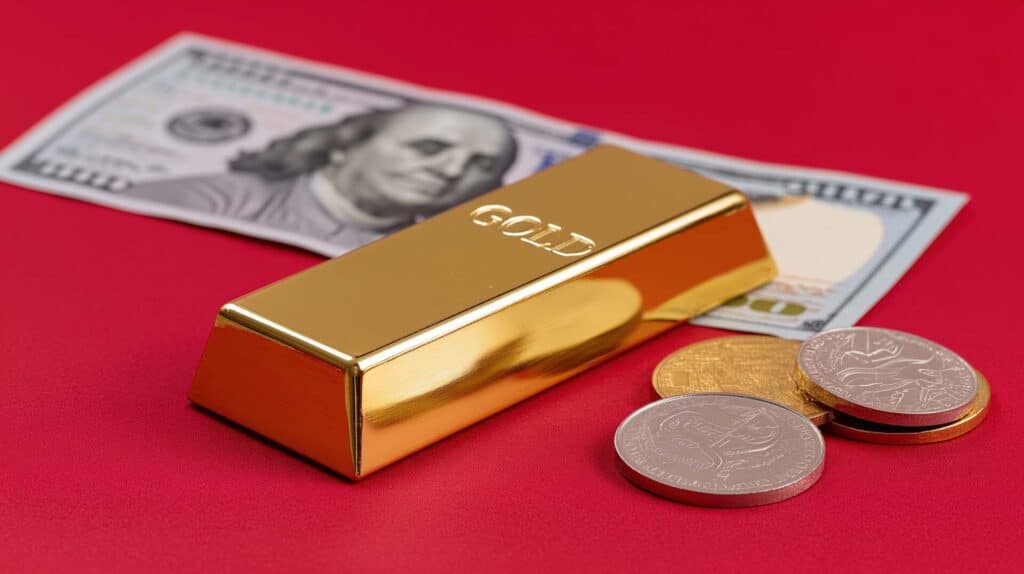

Most people think money is simple. You earn it, spend it, maybe save some. But once you stop and ask what money really is, things start to get less clear.
For thousands of years, different civilizations ended up using the same thing as money. Egyptians, Romans, and empires across Asia all chose gold. Not because it looked nice, but because it worked.
Then the system changed. Money stopped being tied to something real and became something we’re told to trust. It still functions, but over time purchasing power has been quietly slipping. That’s why gold still matters. Not as a trade, but to understand what’s really going on underneath the system.
Gold Is Not an Investment
Most people look at gold like any other asset. They ask if the price will go up or whether it’s a good time to buy. That’s where the misunderstanding begins.
Gold doesn’t produce income. There’s no yield, no dividend, no growth. It simply sits there. But that’s exactly its role.
Gold is not meant to grow your wealth like a business or property. It’s meant to preserve it. It acts as a reference point. When currencies lose value, gold reflects that. When purchasing power declines, gold makes it visible.
So instead of asking what gold will do next, the better question is what your money is doing.
The Real Value Can’t Be Printed
There’s a simple rule that changes how you see money: follow what can’t be printed.
Modern financial systems allow money to be created when needed. More liquidity, more credit, more currency. That flexibility keeps the system running, but it also reduces the value of each unit over time.
Gold is different. It cannot be created by decision. It must be mined, processed, and physically brought into circulation. That makes it limited in a way that most assets are not.
Once you see that difference, it becomes easier to understand where value tends to hold over the long term.
Why Gold Still Matters
Gold wasn’t chosen randomly. It has properties that made it naturally suitable as money. It doesn’t corrode, it’s easy to shape, and it holds its quality over time. Most importantly, it’s scarce.
All the gold ever mined in history would only fill a football field. That’s a surprisingly small amount compared to the size of the global economy today.
This limited supply becomes more meaningful when you look at purchasing power. Two thousand years ago, a Roman centurion could earn about one ounce of gold per month and use it to buy a high-quality outfit. Today, that same ounce of gold can still buy something very similar.
The point is not that gold has increased in value. It’s that it stayed consistent, while currencies changed around it.
From Metal to Paper
Before modern systems, paper money was simply a claim on gold. Holding dollars meant you could exchange them for physical metal. The value of currency came from that link.
After World War II, this structure was formalized under the Bretton Woods system. The U.S. dollar was tied to gold, and other currencies were tied to the dollar. For a time, this created stability.
But by the 1960s, pressure began to build. Government spending increased while gold reserves stayed limited. More dollars were created than the system could realistically support. Confidence started to weaken, and countries began asking for their gold.
In 1971, the system broke. The U.S. ended the dollar’s convertibility into gold, cutting the link completely. From that point on, money became fiat, backed by policy and trust rather than a physical asset.
Fiat, Inflation, and the Shift in Wealth
Fiat currency works because people believe in it. But without a fixed anchor, supply can expand much faster than real value.
Over time, that leads to inflation. Not just rising prices, but a gradual loss of purchasing power. The impact is uneven.
Those holding cash tend to fall behind, while those holding assets often benefit as prices adjust upward. This creates a slow transfer of wealth from savers to asset owners.
It doesn’t happen overnight, which is why it’s easy to ignore. But over longer periods, the effect becomes clear.
Why Gold Is Back in Focus
Despite being labeled outdated, central banks continue to buy gold at record levels. That tells you something important.
Gold is not tied to any single country. It carries no counterparty risk. It cannot be printed or easily controlled. For many governments, it acts as a form of financial independence.
At the same time, global market trends are shifting. Some countries are reducing reliance on the U.S. dollar. Sanctions and reserve restrictions have shown that financial assets can be limited or frozen. Gold, especially when held directly, avoids that risk.
This is why demand is rising again. Not because gold is new, but because the system around it is changing.
Final Thought
Gold is not a perfect solution, and it’s not the only asset that matters. But it does something few things can. It shows you what’s happening beneath the surface.
For 5,000 years, it has acted as a reference point for value. The last 50 years are a short period in comparison. If you follow gold, you start to see how money really works.
And once you see it, it’s hard to look at the system the same way again.